
How Non-Bank Financing Is Leveling the Playing Field in 2026

Access to capital has historically been uneven. Traditional banks have favored businesses with long operating histories, strong credit profiles, and extensive documentation. As a result, many small and mid-sized businesses have been underserved despite having strong revenue potential.
In 2026, non bank financing is changing that dynamic. By offering faster approvals, flexible structures, and broader qualification standards, non-bank lenders are making capital more accessible. This shift is leveling the playing field, allowing more businesses to compete, scale, and respond to opportunities in real time.
What Is Non Bank Financing and How Does It Work?
Non bank financing refers to funding provided by financial technology companies, private lenders, and alternative funding networks instead of traditional banks. These providers offer a range of products, including lines of credit, working capital solutions, and revenue-based financing.
Unlike traditional loans, non bank financing typically relies on real-time business data rather than strict historical benchmarks. Lenders evaluate revenue consistency, cash flow activity, and operational performance to determine eligibility.
One common structure is a revolving line of credit, where businesses can draw funds as needed and only pay for what they use. This creates ongoing access to capital without requiring repeated applications.
For business owners, this means funding is no longer tied to rigid banking processes. Instead, it is aligned with how the business actually operates.
Why Non Bank Financing Is Growing in 2026
The rise of non bank financing in 2026 reflects a broader shift toward speed and efficiency in business operations.
Traditional banks often require weeks or months to process applications. Their underwriting models prioritize risk avoidance, which limits access for newer businesses or those in high-risk industries. While this approach protects the institution, it slows down businesses that need capital quickly.
Non-bank lenders use streamlined systems and data-driven underwriting to reduce approval timelines. Decisions can often be made within hours, with funding delivered in a few business days.
This speed is not just a convenience. It allows businesses to act on opportunities without delay. Whether it is purchasing inventory, launching a campaign, or covering short-term expenses, access to fast capital creates a competitive advantage.
As more businesses prioritize agility, non bank financing continues to gain adoption.

Non Bank Financing Expands Access to Capital
One of the most significant benefits of non bank financing is expanded accessibility.
Traditional banks often require multiple years in business, high credit scores, and substantial documentation. Many viable businesses do not meet these criteria, particularly those in early growth stages.
Non-bank lenders take a broader view. Businesses may qualify with as little as three to six months of operating history, depending on revenue performance. Credit is considered, but it is evaluated alongside other factors rather than serving as the sole determinant.
This approach opens the door for a wider range of businesses, including contractors, retailers, service providers, and e-commerce companies. It also provides options for industries that banks may consider too risky.
By removing these barriers, non bank financing allows more businesses to access the capital they need to grow.
How Non Bank Financing Supports Business Growth
Access to capital is only valuable if it can be used effectively. Non bank financing is designed to support practical, day-to-day business needs.
Businesses can use funding to manage cash flow gaps, invest in marketing, purchase inventory, or expand operations. Because many non-bank solutions are flexible, businesses can draw funds as needed instead of taking on unnecessary debt.
This flexibility improves financial efficiency. Instead of holding unused capital, businesses can access funding precisely when it is required.
For example, a company experiencing a surge in demand can quickly secure funds to increase production. Similarly, businesses can respond to unexpected expenses without disrupting operations.
In both cases, non bank financing allows for faster, more strategic decision-making.
Faster Qualification: How Businesses Get Approved
Understanding how qualification works is important for businesses considering non bank financing.
Most providers focus on current business performance rather than solely on historical records. Revenue consistency is a key factor, as it indicates the business’s ability to manage repayment. Bank activity and cash flow trends are also reviewed to assess financial health.
Time in business requirements are generally lower than traditional banks. Many lenders accept businesses that have been operating for a few months, provided they demonstrate stable revenue.
Credit scores still matter, but they are not the only consideration. This allows businesses with moderate credit profiles to qualify when they might otherwise be declined by a bank.
The overall process is designed to be efficient. Applications are typically completed online, and documentation requirements are minimal compared to traditional lending.
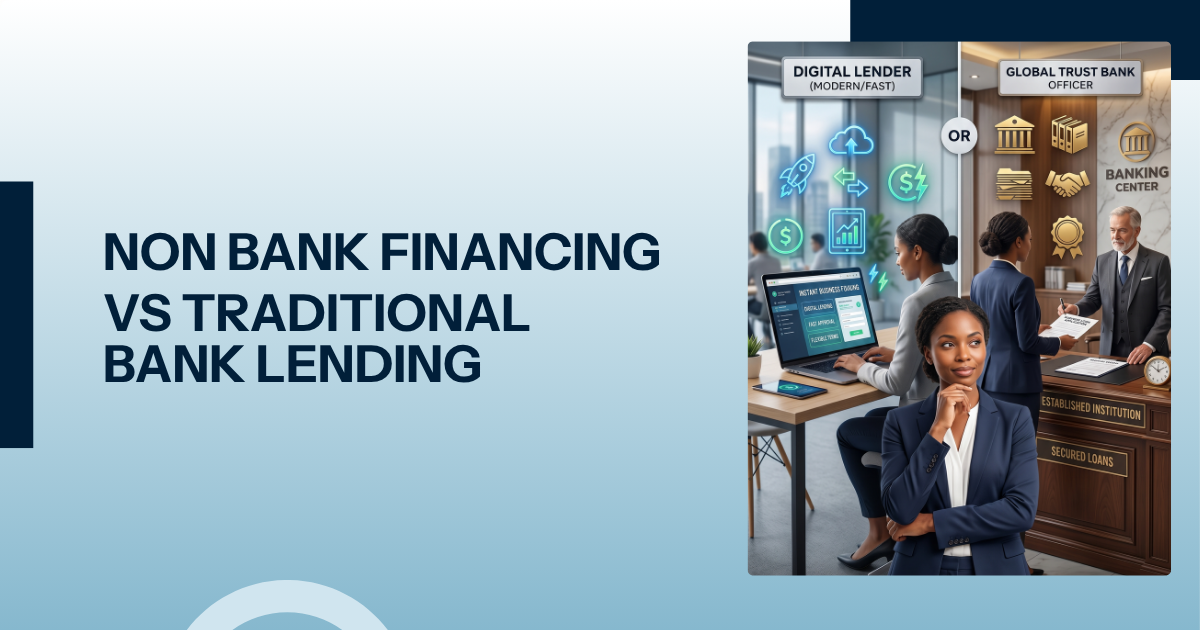
Non Bank Financing vs Traditional Bank Lending
There are clear differences between non bank financing and traditional bank lending.
Banks tend to offer lower rates but require stricter qualifications and longer approval timelines. Their processes are structured and often inflexible.
Non bank financing prioritizes speed, accessibility, and adaptability. While costs may vary, the ability to access capital quickly and use it strategically often outweighs the difference.
For many businesses, the decision is not just about cost. It is about timing and opportunity. Delayed capital can result in missed revenue, while fast access can enable growth.
This is where non bank financing provides a practical advantage.
Why Non Bank Financing Is Leveling the Playing Field
Historically, larger businesses with established banking relationships had easier access to capital. Smaller businesses often faced limitations due to stricter requirements.
Non bank financing is changing that by making funding more inclusive.
With fewer barriers to entry, smaller and mid-sized businesses can now access capital on terms that align with their operations. This allows them to invest in growth, compete more effectively, and respond to market demands.
As a result, the gap between large and small businesses is narrowing. Access to capital is becoming less dependent on traditional credentials and more focused on actual business performance.
This shift is redefining how businesses grow in 2026.
The Future of Non Bank Financing
Non bank financing continues to evolve as financial technology advances. Lenders are improving underwriting models, increasing funding speed, and offering more tailored solutions.
Businesses now have access to a wider range of funding options than ever before. This flexibility allows them to choose solutions that match their specific needs.
As adoption increases, non bank financing is becoming a standard part of business strategy rather than an alternative option.
For growth-focused companies, it represents a more modern approach to capital.
Apply Now: Access Non Bank Financing in Minutes
If your business needs fast, flexible access to capital, non bank financing offers a practical solution.
By focusing on real-time performance and streamlined processes, it provides a way to secure funding without the delays associated with traditional banks.
The next step is to see what your business qualifies for.
Apply in minutes.
Unlock your line of credit today.